- qbittorrent-5.2.3.dmg 46.1 MB 6.9k downloads
- qbittorrent-5.2.3_lt20.dmg 47.0 MB 4.9k downloads
- qbittorrent-5.2.3_lt20_x86_64.AppImage 96.7 MB 5.7k downloads
- qbittorrent-5.2.3_x86_64.AppImage 96.5 MB 3k downloads
- qbittorrent_5.2.3_lt20_x64_setup.exe 43.6 MB 60k downloads
- qbittorrent_5.2.3_x64_setup.exe 41.1 MB 22k downloads
qbittorrent
Desktop BitTorrent client from the upstream open-source project
qbittorrent is a free open-source BitTorrent client people install when they want magnets and .torrent files on a machine they control. Take the Windows x64 setup from GitHub Releases, or use the verified winget and Homebrew doors on the same stable line.
- Local BitTorrent window without a paid seat
- Official Windows x64 setup from GitHub Releases
- GPLv2+ source and GPLv3+ binaries with search and Web UI options
By Magnet Quill editorial team Current release, published July 7, 2026
Install qBittorrent 5.2.3
Windows
Paste into PowerShell or Windows Terminal:
winget install -e --id qBittorrent.qBittorrentPackage: microsoft/winget-pkgs qBittorrent.qBittorrent (YAML-verified). Prefer the Windows x64 setup from GitHub Releases when you want the exact tag asset; winget is the first-party package-manager path..
Other Windows commands
GitHub Releases Windows x64 setup
Windows x64 setup.exe from ReleasesOr download the file directly from the official GitHub release:
Download Windows x64 setup (.exe)Also on this release: Windows x64 setup (libtorrent 2.0 line)
Windows 10 or 11, 64-bit. Prefer the Windows x64 setup from the current release-* tag, or the verified winget id when App Installer is present.
macOS
Paste into Terminal:
brew install --cask qbittorrentPackage: Homebrew cask qbittorrent on formulae.brew.sh (verified). Matching GitHub Releases dmgs also ship on the same tag for default and lt20 lines..
Other macOS commands
GitHub Releases macOS dmg
macOS dmg from ReleasesOr download the file directly from the official GitHub release:
Download macOS .dmgAlso on this release: macOS .dmg (libtorrent 2.0 line)
macOS with Homebrew or a matching dmg from the current release-* tag. Open the official dmg from GitHub Releases when you skip brew.
Linux
Paste into your terminal:
chmod +x qbittorrent-*_x86_64.AppImage && ./qbittorrent-*_x86_64.AppImagePackage: GitHub Releases AppImage on the upstream repo for the current release-* tag. An lt20 AppImage also ships on the same tag..
Other Linux commands
Or download the file directly from the official GitHub release:
Download Linux x86_64 AppImageAlso on this release: Linux x86_64 AppImage (libtorrent 2.0 line)
A 64-bit Linux desktop. Prefer the x86_64 AppImage from the current release-* tag; chmod +x before the first run.
Every file comes from qbittorrent/qBittorrent release-5.2.3 on GitHub, the project's own release, unmodified.
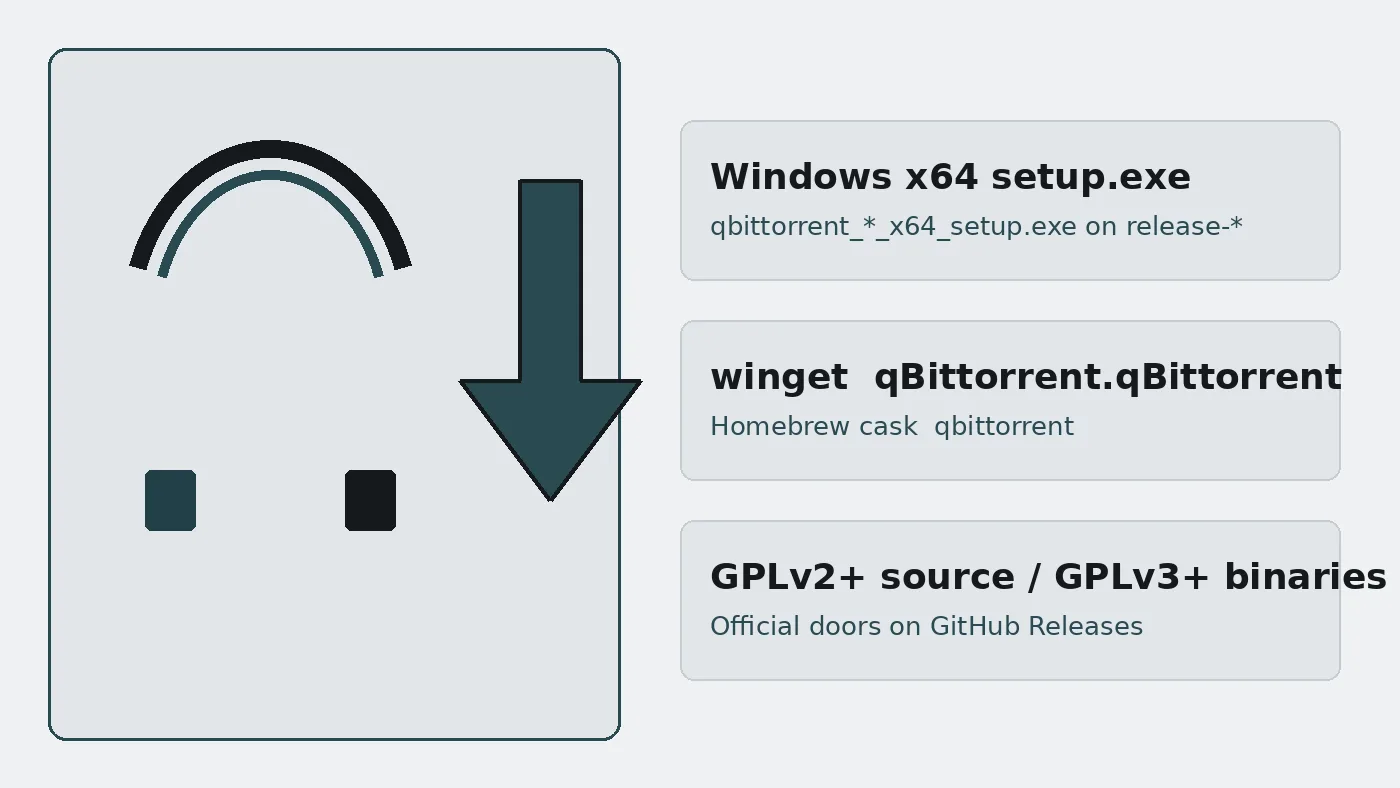
What a qbittorrent job needs
People who type the head term usually want a free BitTorrent client they can install once and keep offline between sessions. The job is magnets, .torrent files, and a transfer list on a PC you control, not a browser demo and not a freemium adware seat.
The upstream open-source project behind that search ships a Qt desktop client. Magnet Quill maps the doors: the Windows x64 setup on GitHub Releases tags prefixed release-, the verified winget id, and the Homebrew cask when those channels are allowed.
Related: releases, GitHub, download safely, Windows install.
LicenceGPLv2+ source / GPLv3+ binaries on GitHub COPYING
Primary fileWindows x64 setup.exe on release tags
Winget / brewVerified winget id · verified Homebrew cask
Why this desktop path
A dedicated BitTorrent client stays on the machine after install. You control the update door. Save paths, speed limits, and optional Web UI settings live in the client instead of a temporary browser tab.
Winget keeps fleet images honest when the catalog is allowed. The setup.exe keeps labs honest when package managers are blocked. Brew keeps Mac desks on the same project without hunting mirrors. AppImage keeps Linux desks on a single file from the same tag.
Commercial or adware clients still win when an organisation already standardised on another brand. Built-in OS tools do not replace a full transfer list. Choose the open-source client when you want GPL source, a named Releases asset, and a desk path that does not start with a paid quote.
Install by operating system
Windows is the primary stranger-safe path with the x64 setup. macOS and Linux share the same stable tag with dmg and AppImage assets, plus verified package-manager commands where they exist.
| OS | Command or file | Package source | Guide |
|---|---|---|---|
| Windows | winget install -e --id qBittorrent.qBittorrent | microsoft/winget-pkgs | Windows install |
| Windows (manual setup) | Windows x64 setup.exe | GitHub Releases · primary stranger-safe | releases |
| macOS | brew install --cask qbittorrent | Homebrew cask · verified | macOS install |
| macOS (manual dmg) | macOS dmg | Same tag · supporting | for this computer |
| Linux | Linux x86_64 AppImage | GitHub Releases | Linux install |
Run the Windows winget line when App Installer is present:
winget install -e --id qBittorrent.qBittorrentRun the macOS brew line when Homebrew is present:
brew install --cask qbittorrentLonger Windows pages: install on Windows. Winget-only walkthrough: winget install. Brew walkthrough: brew cask.
How this client compares
People comparing qbittorrent to other clients pick by licence, platforms, and how much UI they want on day one. Numbers below are product facts, not rankings.
| Client | Price | Open source | Platforms | Notes |
|---|---|---|---|---|
| qBittorrent | Free | Yes · GPLv2+/GPLv3+ binaries | Win / mac / Linux | Qt UI, search plugins, optional Web UI |
| Transmission | Free | Yes | Win / mac / Linux | Minimal UI; strong Mac habit |
| Deluge | Free | Yes | Win / mac / Linux | Plugin-heavy desktop |
| uTorrent | Freemium ads | No | Win / mac | Incumbent search phrase for many Windows users |
| BitTorrent | Freemium | No | Win / mac | Same product family as uTorrent |
Head-to-head: vs Transmission. Leaving adware clients: switch from uTorrent. More comparisons live under guides.
First-hour steps after install
These eight steps match a clean Windows desk. macOS and Linux follow the same prove-one-transfer habit after their own installer doors.
- Open the official release door. Open GitHub Releases for the upstream repository on a current release-* tag and confirm you see the Windows x64 setup.exe, not a renamed portal setup.
- Prefer the Windows x64 setup from the current release tag. Take the Windows x64 setup.exe from the live stable tag. Keep one filename written on the machine ticket.
- Or run the verified winget id. When App Installer is present, run winget install -e --id qBittorrent.qBittorrent. That id is YAML-verified in microsoft/winget-pkgs.
- Finish the installer. Approve UAC when Windows prompts. Complete the setup wizard so the Start Menu shortcut lands where you expect after the first launch.
- Confirm the transfer list opens. Launch the client and confirm the main window lists transfers and filters before you change ports or themes.
- Set the default save path. Open Tools → Options → Downloads and point the default save path at a disk with free space, away from a nearly full system volume when you can.
- Prove one magnet or torrent add. Add a trusted magnet or .torrent so a row appears in the transfer list. That proves the install before you enable the Web UI.
- Keep one update door. Return to the same GitHub Releases filename, winget upgrade, or brew upgrade --cask. Skip adware wrappers that only rank for BitTorrent searches.
First-run detail: first run. After install checklist: installed. Web UI notes: Web UI.
Skip prerelease tags such as beta builds when you want the current stable desk path. Prefer the newest non-prerelease release-* tag that publishes the Windows x64 setup.
Safe download habits
Official doors are the project download page, GitHub Releases for the upstream repo, the verified winget id, and the verified Homebrew cask. Those publish named assets and signatures. Advertising mirrors often rename the setup and bundle extra offers.
Match the filename you expect before you run anything. The primary Windows stranger-safe file uses the upstream x64 setup.exe naming pattern. An lt20 build is a different libtorrent line on the same tag; take it only when you know you need that line.
Deep dive: download safely. Repo map: GitHub overview. Asset chooser: releases.
Save paths, ports, and everyday controls
After the window opens, set the default save path under Tools → Options → Downloads. Point incomplete and finished folders at disks with room. Leaving everything on a tiny system volume fills the drive during large packs.
Connection settings live under Tools → Options → Connection. Note the listening port. Enable UPnP or NAT-PMP when your router allows it and you understand what that means on your network.
Speed limits under Tools → Options → Speed keep a shared line usable during work hours. Queueing options stop dozens of active torrents from starving each other. Prove one transfer before you tune advanced libtorrent knobs.
Lab and travel notes
Travel laptops benefit from a single documented installer door written beside the folder that holds the configuration. Lab images drift when someone installs a second mirror during a blocked SmartScreen prompt. Prefer returning to the same Releases URL, winget id, or brew cask instead of inventing a new download mid-flight.
School machines should receive the installer on hardware they control, plus a shared note for the update door. Shared desks should keep a short prove-one-magnet checklist before calling the image ready.
Classroom images should pin the exact filename beside the OS version. After every reimage, prove one short local transfer before you call the machine ready.
That habit catches vanished portable folders and adware shortcuts that reappear from old bookmark exports. Users who already live in Transmission can keep that path. Treat the Windows setup as the dedicated path for teammates who need a named Releases asset with search plugins and Web UI options on day one.
Support rhythms for shared rooms
Helpdesks move faster when every ticket names the installer door and the Windows build together. Vague reports that only say transfers feel wrong waste a day. Ask for the filename or winget id, the approximate install date, and whether a VPN or firewall changed during the complaint.
- Keep a spare USB with the current setup.exe for rooms without winget.
- Use a quiet prove-one-magnet step before demoing a huge swarm.
- Inventory seedboxes and remote Web UI passwords separately from the desktop binary.
A forgotten Web UI password looks like a broken client. Tag hardware notes with the matching options path so substitutes do not guess under pressure. When imaging season arrives, freeze the golden machine only after a reboot test. Logon scripts and antivirus first-scan delays hide problems that a same-session demo misses. The boring reboot test saves weekend emergency calls.
Writing internal runbooks
Internal runbooks should quote the winget id, the brew cask, and the Releases URL without adding marketing adjectives. Staff skim under stress. A short checklist with five boxes outperforms a three-page essay that nobody finishes.
Include a rollback line: where the previous setup.exe lives, how to uninstall, and who owns the software library hash list. Rollback plans fail when the only copy sat on a retired laptop.
Translate jargon for volunteers. Say “use the official GitHub setup file” instead of assuming everyone knows which mirror is safe. Clarity beats cleverness during the first week of a new semester.
How do I install qbittorrent on Windows?
Prefer the Windows x64 setup from the current release-* tag on the upstream GitHub Releases, or run the verified winget install command when App Installer is present. Both doors map to the same GPLv2+/GPLv3+ binary build for a local BitTorrent client. Avoid renamed setups from advertising download portals that only rank for the head term.
Where should I download qbittorrent?
Use GitHub Releases for the upstream repo, the project download page, the verified winget package, or the verified Homebrew cask. Those doors publish named assets such as the Windows x64 setup on release tags. Softonic-style portals often wrap the same search intent with extra installers you did not ask for.
Is qbittorrent free?
The upstream client is free. Source ships under GPLv2 or later, and official binary builds ship under GPLv3 or later because of bundled assets, with an OpenSSL linking exception noted in COPYING. You can use the desktop client without buying a seat. Optional donations on the project site are separate and are not required for a basic transfer session.
Can I switch into qbittorrent from uTorrent?
Yes. Install from GitHub Releases, winget, or brew, then add your .torrent files and point incomplete folders at the paths you already use. uTorrent settings and ads do not transfer automatically, so rebuild labels and speed limits after you prove one transfer. Guide: switch from uTorrent.
Does the desktop qbittorrent work offline?
The client installs and opens offline after the first download. BitTorrent transfers still need network access when you want peers. You do not need a cloud account for the local window, Web UI optional features, or basic magnet handling once the binary is on disk.
Disk and network habits that age well
After a clean qbittorrent install, large packs fill disks faster than people expect. Keep finished folders on a volume with headroom, and park incomplete data where a full disk will not freeze the OS. Rotate old torrents out of the active list when seeding goals are met so the queue stays readable.
Shared apartments running qbittorrent benefit from daytime speed caps. Overnight windows can run higher limits when nobody is on video calls. Write the numbers on the lab card so substitutes do not guess under pressure during exams.
- Leave headroom on the system volume.
- Cap upload during work hours on shared lines.
- Recheck data after moving folders between clients.
- Keep VPN policy separate from the install door.
Firewall prompts deserve a calm read. Allowing a listen port on a café network is a different decision from allowing it on a home LAN you administer. Document the choice beside the machine name.
Seedbox users still need a local client for the occasional USB handoff. Keep both habits documented so tickets do not mix remote Web UI passwords with desktop save paths.
Imaging season without drama
Golden images that include qbittorrent should freeze only after a reboot and a prove-one-add step. Login scripts that delay first launch hide broken Start Menu shortcuts. Antivirus first scans that quarantine a fresh setup need a known exception path written for the helpdesk.
Borrowing a random USB installer from a drawer is how adware returns. Prefer a hashed copy on trusted media or the same winget id the fleet already allows. When the Store is broken, the Releases setup is the honest fallback.
Pin one update door per lab. Mixing winget one week and a random mirror the next week creates two config folders and two tickets.
Trainers should rehearse the prove step on a tiny trusted torrent so demos stay short. Students learn the habit faster when the checklist fits on an index card. Overnight lab monitors appreciate a note that says which port the client expects.
When a semester ends, uninstall from machines that leave the pool and clear incomplete folders per retention rules. Keep signature verification optional for threat models that require the detached asc files on the same tag.
Writing clearer tickets
Good qbittorrent tickets name the OS build, the installer door, and the exact symptom. Attach a screenshot of the transfer list and the Downloads options path. Mention whether a VPN toggled during the failure. That package of facts saves a day of chat.
Bad tickets say only that downloads feel slow. Slow can mean an empty swarm, a full disk, a polite speed cap, or a blocked port. Ask the reporter to uncheck one change at a time and retry the prove step.
Escalations should include the tag name and the asset filename when a manual setup was used. Package-manager installs should include the winget or brew command verbatim. Substitutes can then recreate the desk without guesswork.
More install and setup guides
-
Install by operating system
Step-by-step installs with the exact command or file for each system.
-
Comparisons
qbittorrent against the other BitTorrent clients people ask about.
-
Switch and import
Move torrents and habits off uTorrent, Transmission, or a browser-only path.
-
Setup and safety
First run, Web UI, update doors, and how the open-source licence class works.
Official releases
All releases on GitHub- GitHub stars
- 40,164
- Downloads, last 1 releases
- 102k
- Latest version
- 5.2.3
Counts come from the GitHub API at build time and only cover the release-* tags shown here. Package managers (winget, Homebrew, Snap, Flathub) and app stores are not included.